Saturday, 22 February 2025

 Stages 101-102: Limerick City to Tarbert, Co. Kerry: Fri/Sat 21/22 Feb 2025. 101km (or 63miles) over the two days

Donald and me at Ringmoylan Pier


Stage 101: Limerick City to Askeaton, Co. Limerick: Friday 21 Feb 2025: 59km or 36.7 miles

‘Limerick you′re a lady, your Shannon waters tears of joy that flow. The beauty that surrounds you, I'll take it with me love, where e′er I go’ Denis Allen
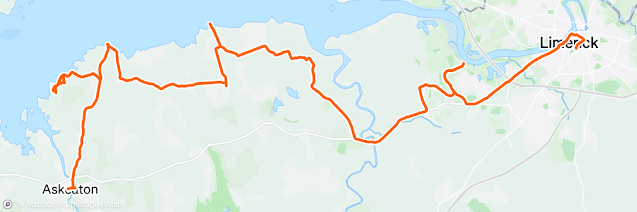
We tried to keep it strictly by the coast today but it was difficult at times

I’m so glad that my friend Donald Smith is joining me to run the Co. Limerick section along the Shannon Estuary. We’re attempting to do these two stages over two days, by only availing of public transport (from Galway) and by just using our own feet. 

Donald and I are up at 5.15am on the Friday morning and after a light breakfast we run the one kilometre from Aideen & Kieran’s (my in-laws) house to catch the 6.22am train from Oranmore. It’s been raining all night but we’re not too wet when we get to Oranmore station. Two hours later we arrive in Limerick City to start today’s adventure. The plan is to run to Askeaton and stay the night there in the ’Top of Town’ pub and continue onto Tarbert on the Saturday morning. The challenge is to complete the whole County Limerick coast in these two days.  

Waiting at Oranmore Station for the 6.22am train to Limerick 

Patrick Sarsfield

The city itself plays a key role in Irish history as it was there that the ‘Treaty of Limerick’ was signed and ended the fighting in Ireland. This was only a year after the famous Battle of the Boyne in 1690. The defeat of King James II by William of Orange wasn’t as decisive as history would lead us to believe.  James’s ‘Jacobite’s’ were still able to defend the lands west of the Shannon and Patrick Sarsfield, the First Earl of Lucan played a big part in this. Sarsfield was a general in King James army and did his best to try to stop William’s invasion into Connacht. Sarsfield, unlike others, believed that Limerick could be defended, even though King William’s men were edging closer to the Shannon. Legend has it that Sarsfield (and his small Jacobite army) tricked his way into William’s Camp as they headed to Limerick. His reputation went before him and the password to get into William’s Camp was ‘Sarsfield’ and the story goes that Sarsfield himself was able to gain entry by shouting ‘‘Sarsfield’s the word and Sarsfield is the man’’ 

Sarsfield’s army then captured 150 wagons of ammunition, 30 cannons and other equipment. It was a moment of glory for the Jacobite army. However, it only delayed King William’s intrusion into Connacht and in July 1691 the Jacobite’s were heavily beaten in the ‘Battle of Aughrim’ in Co. Galway, reported as the bloodiest battle ever in Ireland. After the battle, Sarsfield left Ireland along with 12,000 men and their families as part of an historical episode known as ‘The Flight of the Wild Geese’. He settled in Belgium and was injured at the Battle of Landen in Belgium in 1693. As I write this blog, I have come across a recent and most amazing development. A Dr. Loic Guyon founded a ‘Sarsfield Homecoming Project’ in 2020 with the goal of finding Sarsfield’s remains which he believes are buried in a church in Huy, Belgium. In January 2025 human remains were found in a coffin in Huy and Dr. Guyon says

‘this person would have been close to six foot tall. We’re very hopeful because of the size of this person and the robust nature of the skull and arm bones that it’s a good candidate for it to be Patrick Sarsfield”. 

So, watch this space to see if 332 years later, Sarsfield is still the man. 

With Terry Wogan at 'Poor Man's Kilkee' in Limerick City

When our train arrives at Limerick station, it’s still raining heavily. Donald and I take a right along Parnell Street and then a left at Thomas Street. We make our way down to the river and pause at the Shannon at a place known locally as ‘Poor Mans Kilkee’. Nobody can walk or run through Limerick without thinking about the poverty described by Frank McCourt in ‘Angela’s Ashes’. I remember reading the book years ago when I was stranded at the airport. It did shorten the long wait and later shortened my flight. I was in tears when I eventually arrived at my destination! 

At Poor Man's Kilkee with Terry Wogan

Even before I read the book I knew about ‘Poor Man’s Kilkee’ as I lived in Limerick in the 1980’s. There are no beaches near Limerick City and in times gone by, only those who could afford to, could make the 90km journey to Kilkee. The rest of its citizens had to invent their own version of Kilkee here in the city. Also, by the river there’s a statue of a very famous Limerick man, Terry Wogan. Donald and I pause for a picture. 

We don’t delay too long though as the rain pours down – typical ‘Angela’s Ashes’ style weather. On the very first page of Frank McCourt's excellent book, he describes the weather.

''Out in the Atlantic Ocean great sheets of rain gathered to drift slowly up the River Shannon and settle forever in Limerick. The rain dampened the city from the Feast of the Circumcision to New Year's Eve. It created a cacophony of hacking coughs, bronchial rattles, asthmatic wheezes, consumptive croaks'' 

Donald at Cock Rock by the Shannon Estuary
We continue through the rain, heading west on the Dock Road, going straight through two roundabouts and join the N69. After passing Mungret and the Cement Factory, we take a right. Despite the damp morning we follow a country road that converts to a trail, and we eventually find ourselves on the banks of the Shannon at a place called Cock Rock. I thought we might be able to circle a lake, called Ballindray Creek but there are farm gates to climb over and the trail looks very muddy and rough. We double back and stop at a small shop at Ballybrown or Tervoe Village. We have a great chat with the owner of the store, Martin Hayes and he fills us in on all the local history. He tells us about the Monsell family who were landowners in this area and points to a monument outside his shop erected by William Monsell in honour of his wife, Anna. For all his wealth, Monsell had a tragic life, losing two children in infancy and then his wife Anna at the age of 41. The cross at Tervoe has the inscription

‘On the seventh day of January, in each year, at the foot of the cross, an alms will be given to twenty widows in memory of Anna Maria Monsell, January 7th, 1855’

The Monsell Monument at Tervoe Village, West Limerick

Martin Hayes explains to us that this tradition of giving alms to widows on the 7th of January was kept going for years and honoured until quite recently. We could keep talking to Martin all day. He also tells us about the great Ballybrown hurling team of 1990 when they hired a train to go from Limerick to Belfast to play Loughgiel, Co. Antrim in the All-Ireland Club Semi-Final. Martin Hayes leaves us with a generous donation to Rosedale and a lovely quote about his family’s performance at a bygone match in Croke Park (Jones Road).      ‘All praises to the Hayes for the gallant pluck they showed. For the medals now they’re wearing, that they won in Jones Road’

Crossing the River Maigue at the Ferry Bridge
After our long chat with Martin, we realise that not only has the rain stopped but the sun is shining. We continue running, join the N69 again, and soon reach the Maigue River (pronounced ‘mag’) crossing over what’s called, the Ferry Bridge. The river is 62km long and actually rises in Co. Cork. Interestingly the five line poem, known as a ‘Limerick’ originated in the 18th century in this area. Two local literary enthusiasts were nick-named the Maigue Poets, Sean O Tuama, who died exactly 250 years ago along with his friend Andrias MacRaith. They started writing ‘Limericks’ to each other in the form of insults. All in good humour though. When I tell Donald about this, he composes his own Limerick in honour of me, which I’m sure would have impressed the Maigue Poets.

‘A Galwegian North Downer called Gerry. 

Ran the coast of NI up through Derry.

Did he stop at the Border? 

You'll just have to order, 

His books, PS now he's in Kerry 

(not sure about the last line – also, I thought the Maigue Poets said that Limericks should insult!)

After we cross the Maigue River at the Ferry Bridge, we take a right and follow the quiet country roads in West Limerick. We eventually reach Ringmoylan Pier. It’s a beautiful day now – sunny and even feels warm. I’m thinking about what someone once said about this area, ‘glorious Ringmoylan with its bracing air’.  Across the Estuary we can see Shannon Airport and Bunratty Castle.

The bracing air at Ringmoylan Pier


Despite the beautiful landscape, it's been a long and tiring day for Donald and me. We’re both getting hungry so we head inland a few miles to the only village nearby. It's called Pallaskenry and we're hoping to find a café where we can rest our weary legs for a while. The village was formerly known as Newmarket, and there’s been an Agricultural College here since 1920. (Later, my brother-in-law, Kieran tells me he studied here). Even though it’s a Friday afternoon, there’s not a lot going on in Pallaskenry. It turns out that there’s no café and the only restaurant in the village is closed. We call into a supermarket instead and settle for a coffee and muffin to take way.

Hope we don't meet the 'Children of the damned' - the scariest film I've seen!

We carry on running west and take a loop road all the way down to Beagh Castle on the Shannon shore. The castle was built by the Fitzgeralds as far back as the 13th century. Even before that there is evidence that it was once a Viking outpost.

At Beagh Castle

Donald and me at Beagh Castle

Donald and I investigate the ruins of Beagh Castle and when we leave the harbour, we run inland a little and then follow another route to the coast, signposted Ballysteen Pier. We follow this road and then take a right turn along a trail to the harbour. 

Out standing in my own field! (near Ballysteen Pier)

Donald takes the best pictures - near Ballysteen Pier, West Limerick

We were hoping we could do a circular run here along a rough beach (not exactly Kilkee) but we got a little lost. We eventually spotted a farm but when we tried to reach a farmhouse all our ways were blocked by a wide stream. After much discussion and effort, we made the decision to backtrack all the way to Ballysteen Pier. From there it was a straight run into Askeaton. 

Great hurling support in West Limerick

The sun is setting but we’ve so happy to have reached our destination. I had arranged to stay at the ‘Top of Town’ Pub and when we arrived at the bar, the owner Josh Sheahan recognised us, and we got a great cheer from all the locals. Josh and his assistant, Katie really looked after Donald and me. It felt good sitting down after 59km of running, and walking. There was even a collection later in the pub for Rosedale School and I promised I would drop some books off when I’m back in March. Josh even arranged accommodation for us and refused to take any cash for our lodgings. Thank you, Top of the Town! It has to be the best pub in Co. Limerick. 

Celebrating our arrival in 'Top of the Town', Askeaton


Stage 102: Askeaton Co. Limerick to Tarbert Co. Kerry: Saturday 22 Feb 2025: 42.3km or 26.3miles

O that the pines which crown yon steep, their fires might ne'er surrender! Aubrey de Vere’s poem highlighting the beauty of nature

Running close to the coast was easier today

Donald and I have a deadline to reach Tarbert, Co. Kerry by 2.45pm today as that is the time of the last bus back to Limerick City. Therefore, it’s an early start and the plan is to skip breakfast and run all the way to Foynes and have something to eat there.

Askeaton & the Hell Fire Club: Askeaton is said to be the oldest town in County Limerick. The name translates as Eas Geitini, which means 'the Waterfall of the Geitini (Keatings)'. The Castle was founded by William de Burgo in 1199 and became the home of the Kings of Munster. The author Aubrey de Vere is buried in the grounds of St. Mary’s Church of Ireland. The ‘Askeaton Hell Fire Club’ was a gentleman’s club in the 1700s with ‘tales of outrageous rituals and lurid activities’ to snub clerical authority during evenings of wine, women and song. Margaret Blennerhassett known as Celinda is said to have been the only woman who ever became a member of the Askeaton Hellfire Club. In her curiosity she tried to find out what the men did so she hid herself in the meeting room before they arrived. When they discovered her there, she was formally inducted as a member, to ensure her silence.

Sunrise at Askeaton Pier

Donald and I start our run by following the River Deel northwards, where it flows into the sea. It looked like there was a loop trail here at the bottom of the harbour, but we had to abandon this route as it seemed to go through a farm and cows were lurking around, watching our every move! We headed back up towards Askeaton and joined the N69, heading west. 

Strange traffic on Askeaton to Foynes road

The forecast looks good for today but suddenly the rain comes down. It turns out to be the only shower of the day. After about 3k we are able to join a quieter inner road, Morgans South which actually brings us along a route leading towards Aughinish Alumina. We run down here for a look at the factory before turning back again.

With Aughinish Alumia in the background

Aughinish Alumina 'welcome' sign in three languages

Aughinish Alumina: I worked here as a temporary assignment in the 1980's. The factory, still in operation today, imports Bauxite from west Africa and converts it into alumina, which is the raw material for aluminium. My accounting job back then was to check expenses, make sure they were approved properly and pay them. Alcan, as it was nicknamed then is still a huge complex and is now owned by a Russian company called Rusal. The welcome sign is in Irish, English and Russian. Aughinish itself, although technically an island is not to be confused with the Co. Clare/Co. Galway Aughinish Island. (see Stage 89)

After breakfast in the Foynes Inn
We come back to the N69 again and have a nice long downhill run to reach the town of Foynes. Donald & I have already covered 20k this morning on empty stomachs, so we stop at the Foynes Inn for a delicious breakfast. We needed it. Afterwards we walk up the hill passing Foynes Island (Oileán Fainge or circular island). There is another much smaller island behind Foynes Island with the Latin sounding name of Sturamus. The writer Robert Lloyd Praeger once visited this wee island. He was the author of a famous book called ‘The Way that I went’ describing his trips around Ireland. Maybe he was the original coastal runner or walker! He rubbed shoulders with Yeats and Lady Gregory in Dublin literary circles, climbed mountains, including Mount Brandon in Co Kerry in the company of George Mallory. However, to my knowledge, he never ran along the Co. Limerick coast with a Scotsman. Seriously, I really appreciate Donald’s company today.

Running along the Shannon shore, near Foynes, Co. Limerick

Although our legs are getting heavy, we start running again. We arrive at a beautiful village called Loghill and decide to come inland on a quieter country road signposted Ballyhahill (L1229). The ‘Coastal Audit Committee’ allow me to sometimes run inland as long as the route is not any shorter than the coastal alternative! In any case, it’s much brighter and sunnier up here on this high-country road, almost like one of Co. Clare’s green roads. 

On higher ground along the inland road between Loghill and Glin 

We eventually arrive in Glin. Donald and I are relieved that the sign says only 6km to Tarbert. If it was any further away, we could have considered staying the night in the village. However, that might have been expensive because back in 2018 Taylor Swift spent Christmas in Glin Castle with her partner at the time, British actor Joe Alwyn. It cost them £50,000 for just six days.
View of Glin Castle where Taylor Swift stayed

Soon we come to the best sight of the day. It’s a sign on the side of road which says, ‘Welcome to Kerry’. I’ve finally arrived in the ‘Kingdom’

Welcome to the 'Kingdom' of Kerry

Shortly afterwards we reach the town of Tarbert. It’s about 2.20 pm so we are on time to catch the last bus back to Limerick at 2.45pm. We even have the pleasure of listening to the Wales v Ireland rugby game on our return journey. It’s another Triple Crown win for Ireland. From Limerick City we take the 6.05pm train to Oranmore. What is unique about these two stages is that we did it all by public transport – and by using our own four feet of course.

Saturday, 28 September 2024


Stage 100: Shannon, Co. Clare to Limerick City: Saturday 28 September 2024: 26.2km or 16.3 miles

Taking an inner route to avoid busy dual carriagway
“It’s the same old theme, since 1916. In your head, in your head, they’re still fighting with their tanks and their bombs and their bombs and their guns’’ From Zombie by Limerick’s Dolories O’Riordan and the Cranberries

I arranged to meet Roisin at the parkrun in Shannon.  Even though it’s called Illaunmanagh parkrun it doesn’t feel in any way like an island. However, it is on the banks of Shannon Estuary, and I think some of these wetlands were reclaimed from the sea when they were building the new town.

Roisin and me at Shannon parkrun
I lived and worked in Shannon in the mid 1980’s so it’s strange being back here. It was and still is, an unusual and different type of place compared to your average Irish town. One thing I did observe is that Shannon now seems to be proudly part of Co. Clare. Back in the 1980’s it felt more like it was in ‘no man’s land’ – a new town without any county affiliation. Today the blue and gold colours of Co. Clare are prominent all over the surrounding estates and Shannon is very much part of the Banner County.  

They’re a friendly bunch at the parkrun and very interested in hearing about the Coastal Run idea. The course itself follows a lovely trail through the forest and these forest paths are another great addition to Shannon’s development. I don’t remember them here in the 1980’s. Knowing we have to run all the way to Limerick City I decide to take it easy on the parkrun. Roisin has other ideas, isn’t so cautious and starts to increase the pace. I’m determined to stay with her as she picks up speed and we end up finishing fourth and fifth. It turns out that the man who finished ahead of us in third place, Eamonn Morgan is also from Kilfenora where Roisin lives. Eamonn then joins us for a mile or two on our way to Limerick City.

Roisin & Eamonn - two Kilfenora people
Leaving Shannon, we take the first right turn at the roundabout to Ballycassey (A471) The plan is to run towards Bunratty, but avoiding the main N18 road. (It’s not a motorway but a very busy dual carriageway). We make a mistake here of taking a left turn on this road too early. We should have taken a right turn further on! Eventually we do find the right road on the L3136, signposted to ‘McCabes B&B’. 

Bunratty Castle
We’re glad to stop at Bunratty. It’s turned out to be a beautiful day and Roisin and I are able to enjoy our break at the famous Durty Nelly’s Pub and sit outside in the sunshine in front of Bunratty castle. Afterwards we do have to run on the N18 for about 1500 metres. At least there’s a fairly wide hard shoulder and soon we take a left turn on the Well Road and head for Cratloe.

Outside Durty Nellys in Bunratty
With Roisin in Bunratty
Readers might be wondering why we’re taking this inland route. My reckoning is that firstly, there is
no proper coastal path or even country road to Limerick and secondly it would be too dangerous to run on the busy N18. Hopefully the ‘Coastal Audit Committee’ will accept this explanation, especially as our inland route will take us even longer to reach Limerick.

Even though I once lived in Shannon and Limerick, I’ve never been on this Cratloe Road before. This area is referred to in ancient history and folklore in the ‘Annals of the Four Masters’. They explain how, years ago in Cratloe, Crimthann Mac Fidaig, the High King of Ireland was poisoned by his sister, Mongfind who wanted her own son to be king. She ended up taking her own poison in an attempt to convince her brother that it was alright to drink. It wasn’t safe to take and both siblings died.

Leaving Co. Clare and crossing into Co. Limerick 

We continue on this quiet country road and soon Roisin and I reach the Co. Limerick border. That’s another milestone with Co. Clare now completed. I’m very satisfied with this achievement, considering that in May and June, I was out of action for about seven weeks with my foot injury. 

Thomond Park - home of Munster Rugby
Shortly we come to Thomond Park, the home of Munster Rugby. We go inside for a wee look. I’ve always been fascinated how rugby is such a big sport in Limerick City. The ground has been modernised and now can hold an attendance of 25,600. However, up to the last century the capacity was only 13,000. Yet in 1992, 18,000 crammed into the stadium for a local Limerick derby between Shannon and Garryowen. The most famous match to be played at Thomond was in 1978 when Munster shocked the All Blacks (New Zealand) by 13-0. There’s even a play called ‘Alone It Stands’ by John Breen which celebrates that special evening. That phrase ‘Alone It Stands’ comes from a line in the song ‘There is an Isle’ which is Shannon Rugby Club’s anthem. Shannon RFC is based in Limerick City around the banks of the river, and they also play their home matches at Thomond. As we cross the River Shannon onto Kings Island, we spot a poster with the opening lines of the afore mentioned song.

“There is an Isle, a bonnie isle, stands proudly from the sea and dearer far than all the world, is that dear isle to me’

'There is an Isle'  Shannon's Rugby Club's Anthem
Crossing the River Shannon for the very first time is another event to celebrate. It’s only taken me 3,727km to cross the bridge to King John’s Castle. I’m remembering a time I lived in Limerick in the 1980’s. I wouldn’t say it was a happy place for me because when I was here, I struggled with work and trying to find my way in the world. Roisin also doesn’t have great memories of Limerick, so we had some serious conversations as we make our way through the city. 

Roisin at King John's Castle

At King John's Castle by the River Shannon
It’s a busy Saturday afternoon but we finally reach Limerick Station where we have time for a drink and sandwich before getting the bus back to Shannon to collect our cars. Delighted that stage 100 is now complete!

Mural of the late (and great) Dolores O'Riordan from The Cranberries
Roisin heading to Limerick Station

Saturday, 14 September 2024

Stage 99: Co. Clare: Ennis to Shannon Airport: Saturday 14 September 2024:  39.52km or 24.55miles

“The young, the old the brave and the bold with their duty to fulfil, at the parish church near Clooney, a mile from Spancil Hill” Michael Considine

We had to go inland just before Shannon to avoid getting too close to runways

I’m staying with Maureen’s sister, Aideen in Oranmore so I get the 6.22am train from there. Delighted that Roisin Howley is meeting me in Ennis, and I arrive on time at 7.35am. Roisin is such great company and has already joined me on most of the Co. Clare stages. From the station we take a right along Quin Road and follow the river walk south by the Fergus. The River Fergus will be our constant companion for the rest of the morning.

Roisin meets me at Ennis Station

Ennis is the county town of Co. Clare and except for Galway it’s the largest town west of the Shannon. The name translates as ‘island’, but it doesn’t really have an island or waterway feeling to it, like Galway or Enniskillen. Ennis’s origin was monastic so it never had protected boundary walls. It’s a market town. Even Ireland’s famous Spancil Hill, where they still hold the fair, is only 7km away. The writer of that song, Michael Considine died at a very young age of 23, probably of TB. He was born near Spancil Hill Crossroads, just outside Ennis, but emigrated to the west coast of America around 1870. Michael’s song about dreaming of returning home makes the last lines of the song even sadder.

‘The cock it crew in the morning. It crew both loud and shrill. I awoke in California, many miles from Spancil Hill’.

View of Clare Abbey from Fergus River Path
So far all is going well for Roisin and me as we run along the River Fergus. In our wisdom we decide to try to stay by the river once the main path comes to end. The trail gets rougher, but we keep going until we come to an open area surrounded by trees and bushes. We spot some kind of gap in the corner of the field, so we clamber through brambles and nettles to get to the exit, getting cut and stung in the process. To make matters worse the gap doesn’t bring us onto a lane or a road. Instead, we arrive on the railway line. We walk along the line looking for a way to leave before a train comes along, but the fence is too high on both sides. We have no alternative but to go back the way we came - into the field again – and yes through the brambles, bushes and nettles – and getting cut and stung again! 

To compound our misery a pony comes running over to us as we arrive back in the field. He ends up getting quite frisky and even aggressive. The horse continues to follow us, nudging and even nipping at us and we try to get back to the river trail. Lucky, I have Roisin with me to keep things cool. She encourages me to walk slowly and not to run. It’s a scary time trying to escape from this animal but eventually (that word again that never explains the time and suffering involved) we reach a farmgate and climb over. Phew! Later Roisin explains how she could keep calm. She tells me that when she was younger, she had a pony called Buddy. Yes, Buddy Howley! By the way, we’re calling our aggressive horse by the name, Fergus, after the river. 

So glad that Fergus is on the other side of fence 

It’s now 8.17am. It’s been 40 minutes since we left Ennis Station and we’ve only covered 3km. Not a great start to today’s adventure. At Clarecastle we follow the old road south crossing the River Fergus. Then, for a while the R458 runs parallel to the M18 motorway.

Roisin checking that this is the right way

We spot Dromoland Castle on the other side of the Motorway. The history of the castle goes back a long way. The land was originally owned by the O’Briens, and a castle was built here in the 1500’s. The present main building dates from the 1800’s. Unlike a lot of other big houses, it wasn’t burned down in the 1920’s War of Independence. Apparently, the IRA leaders argued that the Inchiquin Lords at Dromoland had been fair and kind in their dealings with tenant farms and had given relief during the famine. In 1962 Lord Inchiquin sold the castle plus 330 acres of land to Bernard McDonough an Irish-America. It’s now a 5star resort hotel. A minimum two nights stay would set you back about €5,000. Lots of famous people stayed here – even the Beatles in 1964 and there’s a strange YouTube piece of George Harrison & John Lennon having a sword fight outside the castle!

I had read that a Fairy Bush almost had to be destroyed when building the M18 Motorway. Protesters argued that interfering with the fairy tree ‘could result in misfortune’. Roisin and I stopped at the roundabout and tried unsuccessfully to find exactly where the Fairy Tree was. 

We leave the R458 and follow the L3156 signposted to Ballygirreen. After about 3km we take a right along Latoon South. We follow this crooked road all the way to Ing West and Ing East and then cross a couple of fields and arrive down on the shoreline of the Fergus Estuary. There’s a lovely grassy embankment along here by the coast which is perfect for running on. However, there are lots of cows in the area, so we act very cautiously, especially after our earlier experience with Fergus the pony. We continue to follow the coastline, pass Breckinish Island and finally reach Ballymacnevin Castle where we join the country road again. I couldn’t find any information about this castle. There’s no access to it and we can see trees growing inside.

At Ballymacnevin Castle

I’m in an area now called Carrygerry which is very apt for how I’m feeling right now – although I think I’m too big for Roisin to carry me! We pass a Holy Well, which seems to be well maintained but there’s no name on it. No water in it either!

The Holy Well with no name - or water

We continue south and come to St Conaire’s Catholic Church. The story is that Conaire was a nun from west Cork who came to visit her cousin Saint Senan, at his monastery on Scattery Island, near Kilrush. Senan would not allow ‘his sacred isle to be tainted by a female presence’. Not a very nice way to treat a family member who had travelled about a hundred miles (and this happened probably 1,000 years ago). The good news though was that as Sister Conaire came ashore in the Carrigerry area she was welcomed by the natives, and they even made her patron of the parish of Carrigerry. In fairness to Saint Senan, he also built a convent (just for nuns) on nearby Feenish island.

Yes I wish someone would carry me!
St Conaire Church

We come to Carrygerry Country House – built in 1793 but since 1988 restored and renovated into a Country house hotel. I’m impressed that there’s a Galway flag outside. (we’ve seen so many Clare blue and gold flags this morning which is very understandable as Clare are 2024 All Ireland Hurling Champions). 

I was impressed that the Galway flag was flying in Co. Clare

At this stage we’re looking for a right turn that will take us to Inishmacnaghtan Island and towards Feenish Island (not to be confused with Feenish Island in Connemara). In 1858 the owners of the two islands found themselves in court in a case listed as O’Farrell v Frost. The former asserted his right of way through the bigger island as the latter had prevented him accessing the mainland by this route.

When we reach the turn to get to Inishmacnaghtan Island there is a big gate at an entrance. The gate is open but there is a ‘private property’ sign on the wall. Roisin and I debate for a few minutes as to whether we should continue along the lane. Suddenly a jeep pulls up and we get talking to two young family members. They give us permission to run through their land and we cross onto Inishmacnaghtan island itself. It’s a short causeway, probably only 15 metres across. Previously before land was reclaimed in the 1980’s the island was cut off completely and would have been 100 metres from the mainland.

Crossing causeway to Inishmacnaghtan

Flight TWA 6863:  On 28 December 1946 a plane called ‘The Star of Cairo’ was having a stopover on its flight from Paris to New York when it crashed onto Inishmacnaghtan. Perhaps some of the passengers were lucky that the accident happened on this marshy and boggy island. Of the 23 people on board, 14 survived including a four-month-old baby who had been thrown out of the plane and was heard crying before it was rescued. The fact that the island was then separate from the shore made rescue attempts very difficult.  

View of Feenish Island from Inishmacnaghtan

Back in 2024 Roisin and I continue running to the western tip of the island. The tide was coming in now so there was no access to Feenish Island. All we could do was look across. To be honest on a dull day like today it didn’t look very attractive. I read that on Feenish Island there is evidence of a battle or slaughter of sixty men that took place hundreds of years ago. It’s known as ‘Poll na dTri Fiche’ (grave of the sixty).

We return to the mainland and continue running south. We did wonder how far we could get trying to access the Airport from this angle. We reach the Honk Bar. The Quinlivan family have been running the pub for over 200 years and long before the town of Shannon was built. Previously the townland was known as Rineanna. I should be a bit familiar with this area as I lived and worked in Shannon town between 1984 and 1987. We get chatting to a man who tells us that there is no access to the Airport from here. We’re pleased that he’s told us this as Roisin and I had roughed it enough today and didn’t fancy climbing over security fences. 

Roisin running near Drumgeely, Shannon Town

So, we backtrack a little and follow a road east that brings us into Shannon Industrial Estate. From there we eventually make our way to our finish point at Shannon Airport just in time to get the bus back to Ennis and Oranmore.

At last - arriving in Shannon